
 Host Login
 Members Login


The Office Has Become a Lifestyle Choice. Here Is Why That Changes Everything.
 Published by:
Admin User
•
Published by:
Admin User
•
 Published on: 06-09-2026
Introduction
For most of the last century, choosing an office was straightforward. You needed desks, meeting rooms, a phone line, and proximity to your team. The building was a utility. Nobody really asked whether they liked being there.
That era is over. The office today is something workers actively choose, or actively avoid. And what drives that choice has very little to do with square footage or lease terms. It has everything to do with experience.
Attendance was never the right measure
Since COVID, the industry has been obsessed with one question: are people coming in? Occupancy dashboards, badge swipe data, mandates from CEOs. All of it pointed at the same metric. Bums in seats.
Savills argued in its September 2026 Impacts research that attendance tells only part of the story. The more important question is what people do when they get there, and whether the office is helping the business perform. Their survey of over 240 global corporate real estate leaders found that 99% believe the office plays an important role in culture, collaboration and innovation. Only 13% primarily see it as a cost to manage.
The office, in other words, has a clear purpose in the minds of the people running organisations. The problem is that too many offices are failing to deliver on it.
The office has split into three very different things for three very different people
One of the clearest findings from our Voice of Customer research at Spaces to Places , research is that there is no single type of office worker anymore. We identified three distinct personas, each with different motivations and different requirements.
Innovators make up 23% of the market. They are typically younger, tech-savvy, high earners who prefer flexible workspaces. They already attend 3 to 4 days a week and, given the right environment, 77% would increase that further, adding an average of 2.1 days.
Wellness Seekers are the largest group at 39%. They prioritise work-life balance above everything and currently come in just 1 to 3 days a week. They are also the most at risk of reducing attendance further if the experience does not meet their expectations. But 69% said they would increase their office time given the right amenities.
Maximisers, at 28%, are the most reliable. They tend to be older, in more traditional roles, and already attending 4 to 5 days a week. They value efficiency, structure, and the feeling of being organised.
The practical implication is that a single office product cannot serve all three equally well. The Innovator wants collaborative space and the latest technology. The Wellness Seeker wants quiet, comfort, and a sense that the space respects their time. The Maximiser wants reliability and control. Getting this right is not about doing everything. It is about knowing what your office is for.
There is now extraordinary variety in what an office can be
More than 70% of UK flexible workspace providers are independents with 1 to 3 locations. They sit alongside regional operators, national chains, and global brands. Between them they have created a market of extraordinary breadth especially in London. Coworking spaces with a strong community identity. Managed offices for teams that want their own branded environment. Serviced offices with short-term commitments and all-inclusive pricing. Private members clubs for solo workers who want atmosphere. Neighbourhood spaces for people who want to skip the commute without working from the kitchen table.
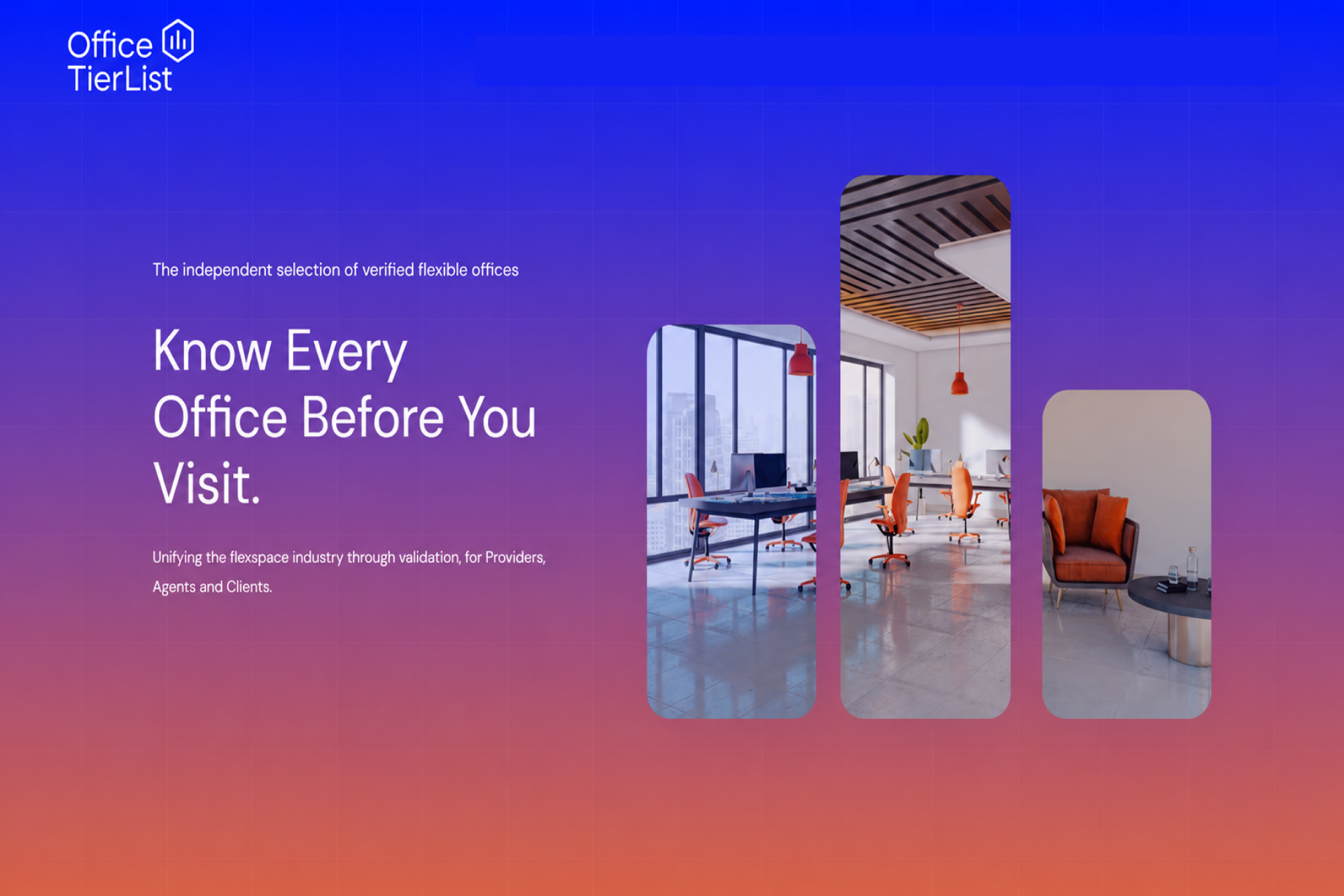
The problem is that this variety has historically been very hard to navigate. This is exactly the gap that Office Tier List was built to fill. Launched in March 2026, it is the UK's first independent marketplace for flexible office space, covering coworking and serviced offices across Central London, with the rest of the UK to follow. Businesses can search, compare, and contact providers directly. Office providers that have an independent in-person inspection earn a verified badge, giving businesses genuine confidence that the listing reflects reality.
The tipping point nobody talks about
Our research uncovered something that has significant practical implications for anyone running a business. When 60 to 70% of a team is present in the office on the same day, employees report finding genuine value in being there. Below that threshold, attendance starts to feel pointless. Above it, something different happens. People start coming in because they do not want to miss what is happening.
Savills found in their research that only a third of organisations currently track employee retention or talent outcomes in relation to their office strategy. Fewer still track productivity or collaboration metrics. The measurement gap is real. But the relationship between office experience and business performance is there, even when organisations are not yet measuring it formally.
What a good office actually looks like in 2026
The universal priorities from our research are less glamorous than you might expect. High-speed internet tops the list at 47%, followed by printing and copying services at 38%, and private offices at 35%. That last one matters. The demand for private space is a direct response to 6 years of workers learning to control their own environment at home. Open-plan offices that offer no refuge are increasingly unpopular, regardless of how well they are designed.
Beyond the basics, the offices performing best in our research are the ones doing something specific rather than something generic. The Innovator wants a space that feels like it belongs to a particular world. The Wellness Seeker wants somewhere that shows it has thought about them as a person. The Maximiser wants somewhere that works, reliably, every time.
An office designed with a clear understanding of who it is for will almost always outperform an office designed to appeal to everyone.
Where this leaves business
If you are a business looking for workspace, the starting point is understanding what your team needs. Not what you think they need, and not what you read in a headline about what Gen Z workers want. The variety in today's market means there is almost certainly a place that fits. The challenge is finding it.
Office Tier List covers over 500 offices across more than 40 London neighbourhoods, with independent verification of the best providers. It is free to use and gives businesses a direct line to providers. If you are starting a workspace search, it is worth a look before you call anyone.
Zoe Ellis-Moore is the founder of Spaces to Places, a fractional marketing and research consultancy specialising in the UK flexible workspace sector, and co-founder of Office Tier List.